


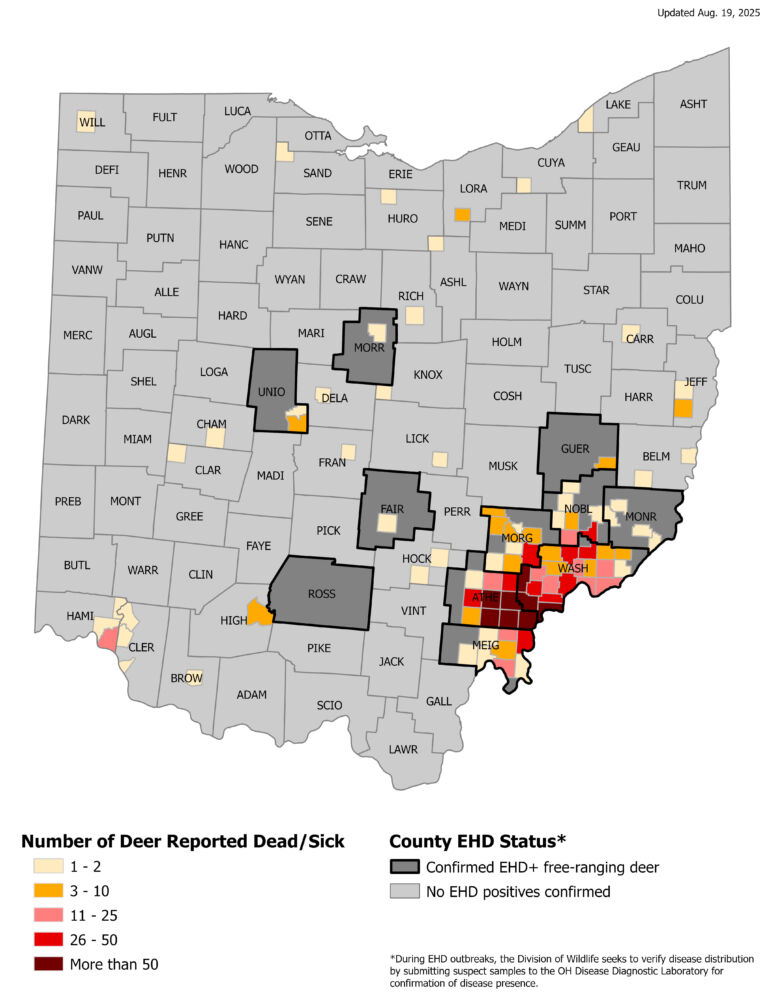
According to preliminary figures released by the Ohio Department of Natural Resources (ODNR) Division of Wildlife, harvest numbers in several southeastern counties dropped well below the five-year average. In Athens County, hunters reported roughly 730 deer taken, compared to an average near 900 over recent years. Meigs County recorded approximately 680 deer—down from its usual range of 850 to 900. Meanwhile, Morgan County hunters harvested about 720 deer, a slight decline from an average near 950, and Washington County reported around 760 deer, down from 1,000 in 2023.

Wildlife biologists point to EHD as the primary factor behind the diminished harvest. The viral disease, transmitted by biting midges, causes internal hemorrhaging and sudden death in infected deer. It is not transmissible to humans or livestock, but its impact on local deer herds can be devastating. “EHD outbreaks tend to appear during hot, dry summers when midge populations thrive near stagnant water,” said Todd Haines, District Four Manager for the Division of Wildlife. “We saw significant deer mortality in several parts of southeastern Ohio this year, particularly in low-lying areas near rivers and ponds.”
Field reports from hunters and trail camera surveys conducted in early autumn supported the agency’s findings, with many locals noting fewer sightings of deer and smaller herds in areas historically rich with wildlife. “Normally, once November rolls around, I’ll see groups of six to eight deer during a morning hunt,” said Michael Adams, a veteran hunter from Meigs County. “This year, I was lucky to spot two or three in a weekend. You could tell the numbers were down.”

Despite the reduced harvest, ODNR officials say the overall statewide total remains healthy. More than 70 counties still reported stable or slightly above-average deer numbers, with robust populations in western and northern regions that were unaffected by EHD. The agency emphasized that deer numbers in southeastern Ohio should rebound over the next few years as surviving populations reproduce and conditions normalize.
Wildlife officers also reported a safe hunting season, with few accidents or enforcement incidents. “Hunters adapted well despite the challenges,” Haines noted. “We encourage sportsmen and women to continue reporting any unusual deer activity and to participate in next year’s archery and muzzleloader seasons, which remain vital tools for managing Ohio’s deer herd.”

Looking ahead, wildlife biologists plan to monitor deer health closely and evaluate long-term effects from this year’s outbreak. They also encourage landowners to reduce stagnant water sources that can harbor midges responsible for transmitting EHD. Though the 2025 deer gun season may have ended on a quieter note than usual, conservation officials say the state’s deer population remains resilient—and so does Ohio’s enduring hunting tradition.